

George Davis literally wrote the textbook on structural geology and has made significant contributions to tectonic and structural understanding of the Southwestern US and Greece, along with broader models such as metamorphic core complexes. He has spent most of his career at the University of Arizona where, through his teaching and textbooks, he has inspired many many geology students to become successful field-based geologists, including the owner of Brunton herself.
Now during his "retirement", Dr. Davis continues to conduct field work, publish papers, and serve the geological community through his roles on various boards.
Learn more about Dr. Davis through his University of Arizona page.
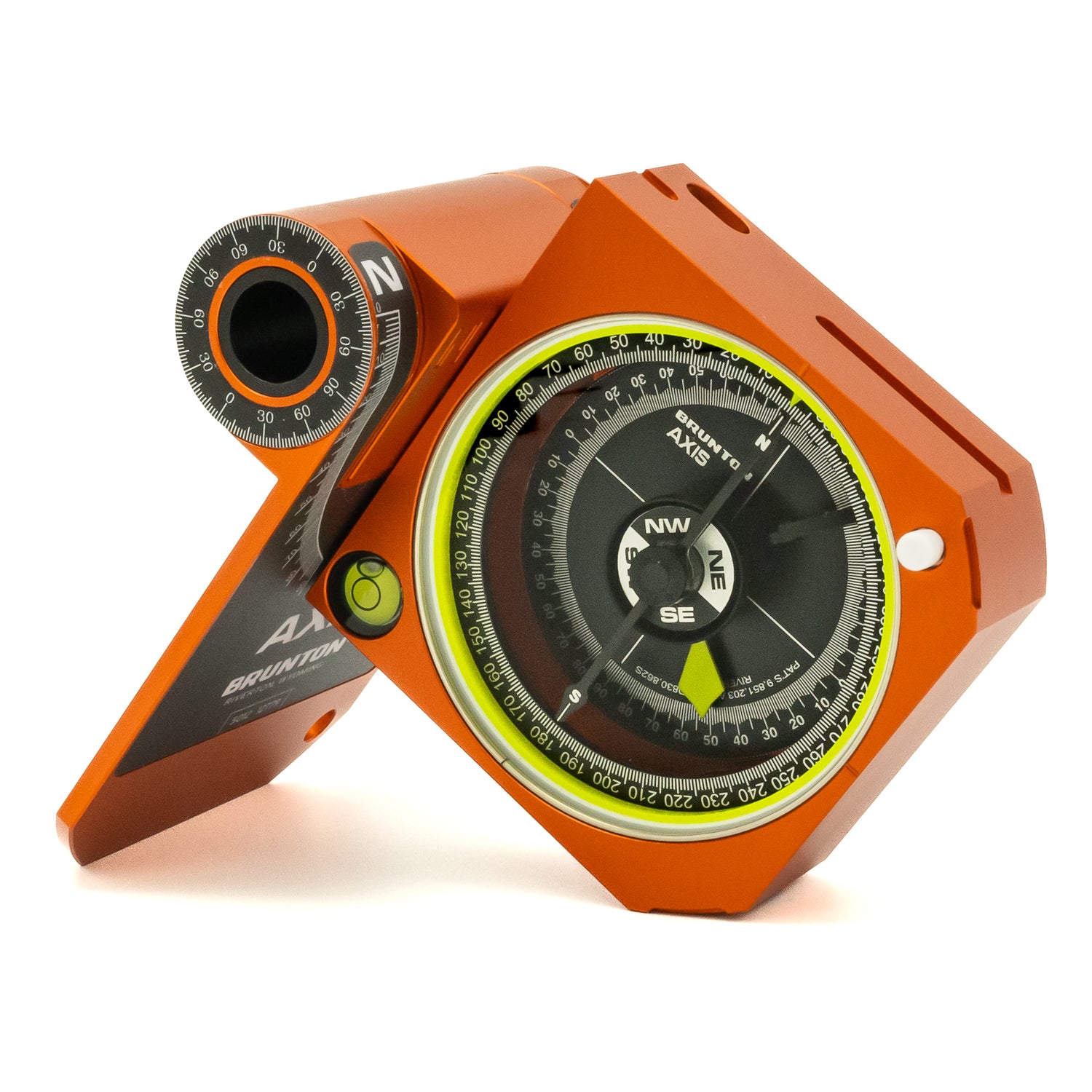
When Dr. Davis got to use an Axis Transit for the first time, he was "blown away by its inventiveness". He became a fan of this new model and its measurement capabilities, and we were fortunate to get to spend a day in the field with him in his home territory around Tucson in early 2025. We even taught him how to take a Brunton Selfie (title photo featuring our new Purple Standard Transit)!
Check out these videos to learn and see what Dr. Davis loves about the Axis:
- George's Axis Overview: 3 Favorite Things
- Taking Paired Measurements: Strike & Dip, Trend & Plunge
- Challenging Surfaces: Near-Horizontal Planes and Steep Lineations
- "Surgical" Structural Measurement Capabilities

Here are some of his written testimonies about the Axis:
"What I really like about the Brunton Axis is its surgical capacities. As a structural geologist, I find it essential to cross scales from outcrop to subregional. In both endeavors, the largest percentage of my time in the field has been describing and measuring structures and fabrics from outcrop to outcrop. I am attracted to projects where outcrops are loaded with penetrative structures and fabrics, such as foliation, lineation, folds, deformation bands, and the like, and different generations of these. Commonly, the structures and fabrics I am measuring are very small. Working at this scale, the compass matters, more than if I were always measuring big bold fault surfaces or bedding attitudes."
"In these circumstances, compass measurements cannot be generalized but need to be precise and as accurate as possible. The built-in lid of the Axis Brunton, and the multi-axis configurations of the moving parts of the compass, permit precise, accurate 3D characterization of even very small structures and fabrics. Some small part of the lid, or some small edge of the lid, can be made flush with the structure being measured. Moreover, the Axis permits trend and plunge of a linear feature to be measured in one set-up of the compass, assuring that the two readings ‘fit.’"
"One more thing. The Brunton Axis can manage strike-and-dip orientations of very shallow dipping planar features, and trend and plunge of very steep linear structures. These are normally the most difficult to measure with any kind of precision and accuracy. In measuring very shallow features, the big issue is strike orientation. Small differences in the tilt of the compass will produce wide shifts in strike direction. Using the Axis, we can hold the compass in a position flush with the orientation of the shallow-dipping surface and still lock in readings for viewing and recording. The shape of the compass permits this. The issue for a steeply pitching linear structure is measuring trend. By eye it is impossible to ‘see’ the trend of a near vertical lineation, let alone orient a compass properly. Using the Axis I can fit the edge of the the lid parallel to the lineation and lock in the readings."

1 comment
Nice story. Having spent months out in the field in western Wyoming decades ago with a traditional Brunton and a Jacob’s staff, I now see I need to get a Brunton Axis. I will be picking up my field work again as a semi-retired geologist.